In the chaotic world of football, fairytale endings are rare—and tragic collapses far more common. From mismanagement to financial ruin, several once-proud EFL clubs have gone under since the 1990s. Some fell from grace with a whisper, others imploded in spectacular fashion.
But as dark as those days were, they weren’t the end. In true phoenix fashion, fans, local businesspeople, and entire communities stepped in to bring these clubs back to life.
Here are the detailed stories of notable ex-EFL sides that ceased to exist—and the legacy clubs that rose in their place.
Bury F.C.
Year Founded: 1885
Folded: 2019
Reborn As: Bury AFC → Merged to become Bury FC again (2023)
What Happened:
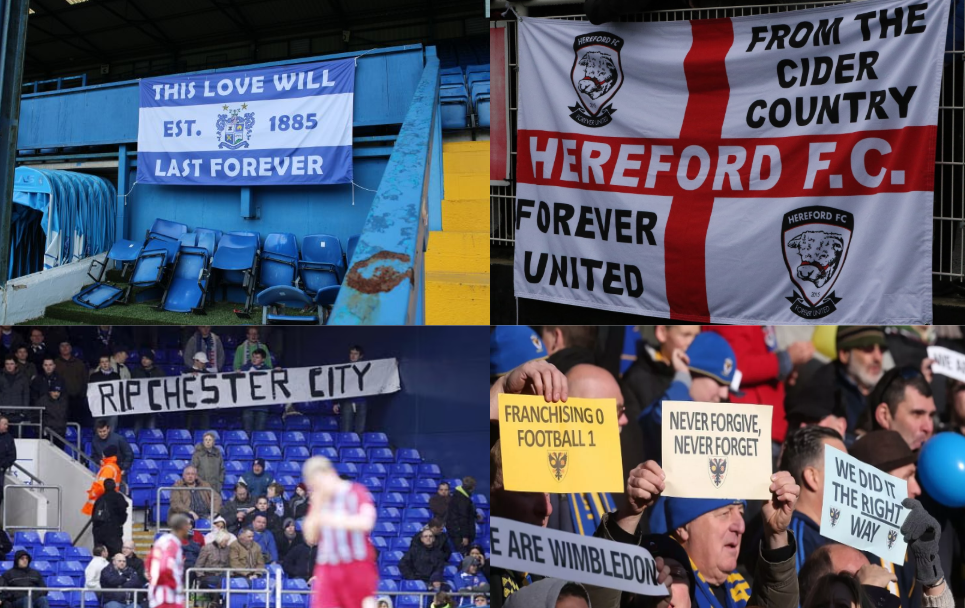
Bury’s demise was one of the most high-profile in recent memory. Owned by property developer Stewart Day, the club’s finances became increasingly unstable. Day had used Bury as collateral for his ailing business empire. In 2018, he sold the club to Steve Dale—an unknown figure with no background in football, and a trail of dissolved companies behind him—for just £1.
Dale made no investment in the club and allowed debts to pile up. Players and staff weren’t paid, creditors were ignored, and eventually the club was expelled from the Football League in 2019 after failing to prove it could fulfil its fixtures.
The Revival:
Supporters quickly launched Bury AFC, a fan-run club that entered the 10th tier. Meanwhile, another fan group—Est. 1885—was working behind the scenes to reclaim the name, stadium, and legacy. After Dale was declared bankrupt in 2022, a deal was brokered (with the help of American-based millionaire fan Peter Alexander) to buy Gigg Lane and the original identity. In 2023, Bury AFC merged back into Bury FC, reviving 134 years of history.
Darlington F.C.
Year Founded: 1883
Folded: 2012
Reborn As: Darlington 1883 → Darlington F.C. (name restored in 2017)
What Happened:
A fourth-tier regular for decades, Darlington’s financial woes were worsened by an utterly baffling decision by chairman George Reynolds in 2003: build a 25,000-seater stadium despite average attendances of just 2,000. Reynolds, a former safe-cracker turned businessman, plunged the club into massive debt.
Darlington entered administration three times (2004, 2009, 2012), with multiple owners failing to stabilise finances. By 2012, they were on the brink, having shed all their playing staff.
The Revival:
Supporters created Darlington 1883, a fan-owned club, which began life in the Northern League Division One. After gaining several promotions and eventually regaining control of their old name, the club is now officially Darlington F.C. again—still going, and still proud as they currently play in the National League North.
Wimbledon F.C.
Year Founded: 1889
Folded: 2002 (Relocated)
Reborn As: AFC Wimbledon (2002)
What Happened:
The story of Wimbledon is perhaps the most controversial in English football. Once a fourth-tier side, the “Crazy Gang” famously won the FA Cup in 1988 and became a founding member of the Premier League. But by the early 2000s, the club had fallen on hard times—crowds had shrunk and they were homeless, sharing grounds after Plough Lane was condemned.
Then came the move. In 2002, the FA approved a relocation to Milton Keynes, 60 miles away—a move previously unthinkable in English football. The club eventually rebranded as MK Dons, attempting to retain Wimbledon’s history and honours.
The Revival:
Disgusted, fans formed AFC Wimbledon just months later, starting in the Combined Counties League (9th tier). Remarkably, they gained promotion to the Football League by 2011 and now play just yards from their original Plough Lane ground. Fierce rivals of MK Dons, most football fans consider AFC Wimbledon the true continuation of the original club.
Funnily enough… AFC Wimbledon now play in League One, whilst their bitter rivals MK Dons play in League Two.
Halifax Town A.F.C.
Year Founded: 1911
Folded: 2008
Reborn As: FC Halifax Town
What Happened:
Relegated from the Football League in 1993, Halifax Town never quite recovered. Financial pressures mounted, and after narrowly avoiding relegation in 2008, they were placed into administration with debts of around £2 million (including £800,000 owed to HMRC). The Conference expelled them, and the club ceased operations.
The Revival:
FC Halifax Town was born from the ashes—technically a new entity, but run by many of the same people and with the same colours, badge, and fanbase. They restarted at level 8 and are now back in the National League. A young Jamie Vardy once played here, catching the eye of Leicester scouts.
Hereford United
Year Founded: 1924
Folded: 2014
Reborn As: Hereford F.C.
What Happened:
Once a Football League regular, Hereford slipped into non-league football and fell into financial ruin. New owner Andy Lonsdale—a convicted criminal—failed to prove he could fund the club. His excuse for missing a crucial court hearing? He was stuck in traffic. The club was wound up shortly after.
The Revival:
Fans and local businessman John Hale formed Hereford F.C., backed by a supporters trust that retains majority ownership. The club now plays in the National League North, holding onto the passion that made Edgar Street a fortress.
Macclesfield Town F.C.
Year Founded: 1874
Folded: 2020
Reborn As: Macclesfield F.C.
What Happened:
After decades in the lower leagues, Macclesfield were plagued by poor ownership and mismanagement. Players weren’t paid, the FA issued points deductions, and they were eventually relegated and wound up in court. No buyer stepped forward.
The Revival:
Robert Smethurst purchased the club’s assets and created Macclesfield F.C. Former Wales midfielder Robbie Savage joined the board, and the club restarted in the North West Counties League—winning the league in their first season.
Last season, Macclesfield won the Northern Premier League Premier Division and will now play in the arguably the toughest league in non league football, The National League North. Sadly, without Robbie Savage at the wheel due to him moving to Forest Green Rovers.
Maidstone United F.C.
Year Founded: 1897
Folded: 1992
Reborn As: Maidstone United (New entity)
What Happened:
Promoted rapidly through the leagues, Maidstone gambled heavily on player wages and infrastructure. Their biggest mistake? Paying £400,000 for land for a new stadium without securing planning permission. The plan backfired spectacularly. With mounting debts and no stadium or squad, they folded just before the 1992 season.
The Revival:
A phoenix club was formed soon after. Today’s Maidstone United is fan-run and currently played in National League South.
Scarborough F.C.
Year Founded: 1879
Folded: 2007
Reborn As: Scarborough Athletic
What Happened:
After years of struggling in the lower leagues, financial problems finally overwhelmed Scarborough, who owed over £2.5 million by the time they were dissolved. Efforts to sell the ground failed to rescue them.
The Revival:
Fans established Scarborough Athletic under The Seadog Trust, starting in the 10th tier. The club now plays at the Flamingo Land Stadium and has slowly climbed up the pyramid again to the National League North.
Chester City F.C.
Year Founded: 1885
Folded: 2010
Reborn As: Chester F.C.
What Happened:
Chester were in long-term decline, suffering two relegations to the Conference. Starting the 2009–10 season with a 25-point deduction, they could never recover. With mounting tax debt and failure to agree a rescue plan, they were wound up in March 2010.
The Revival:
Fans formed Chester F.C. immediately after. The new club is 100% fan-owned and has risen back to the National League North. Supporters say it’s the club they always wanted—free from the toxic ownership of the past.
 MatchDay Fever
Leave a comment